







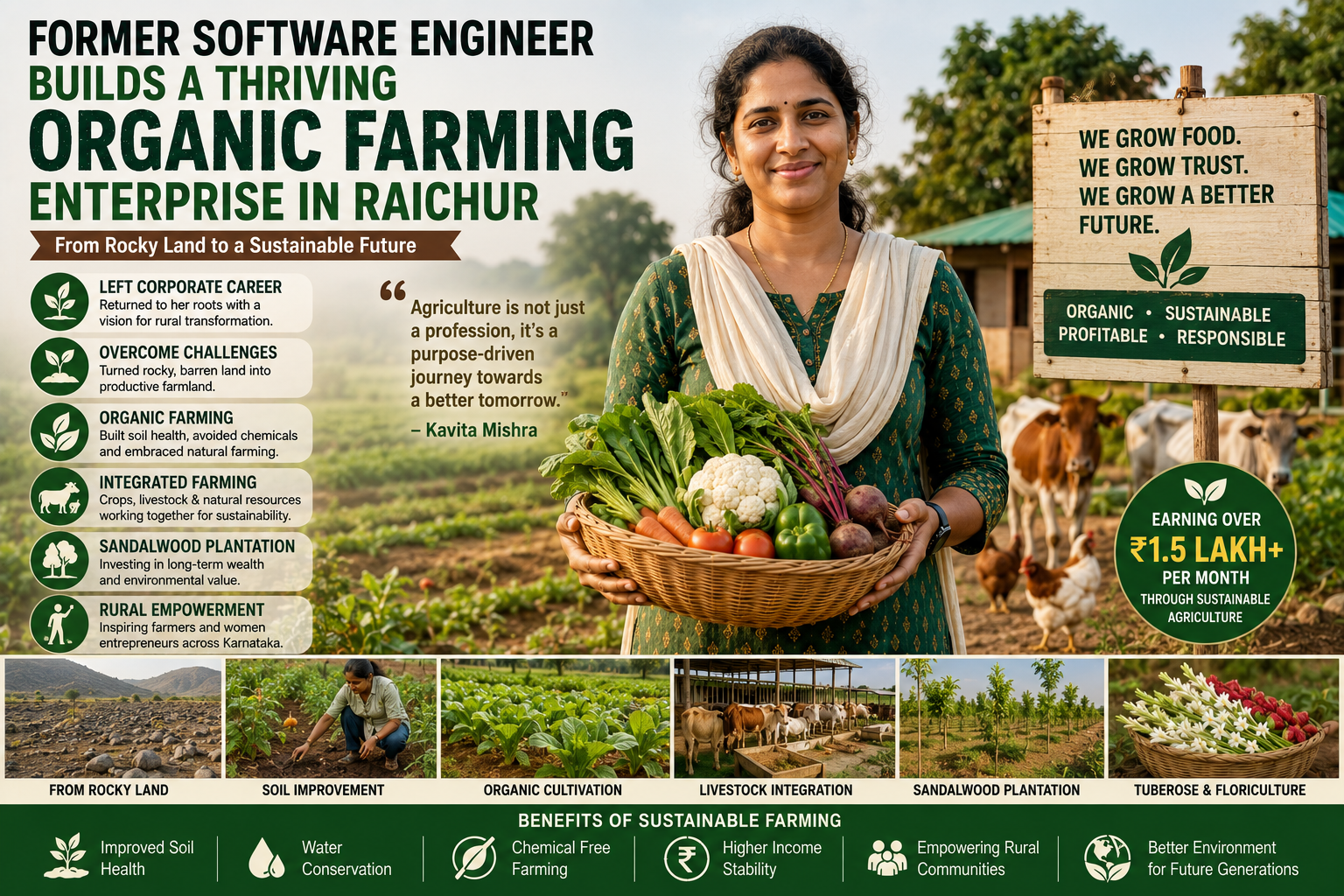
In an era where many professionals seek purpose beyond corporate careers, the story of Kavita Mishra from Raichur, Karnataka, stands out as a remarkable example of determination and innovation. A former software engineer, Kavita left behind a stable corporate career to pursue agriculture on her ancestral land. What began as a challenging journey on rocky and barren farmland has now evolved into a successful agricultural enterprise generating substantial monthly income. Through Organic Farming, integrated agricultural practices, and a commitment to sustainability, she has transformed her farm into a model of rural entrepreneurship. Her journey demonstrates that with knowledge, perseverance, and the right farming approach, agriculture can become both profitable and environmentally sustainable.
Leaving the Corporate World for Agriculture
Kavita Mishra spent years building her career in the software industry. Like many professionals, she enjoyed the benefits of a stable income and urban lifestyle. However, she felt a growing desire to reconnect with her roots and contribute meaningfully to rural development.
This aspiration led her back to her ancestral village in Raichur district. While many considered the decision risky, Kavita viewed agriculture as an opportunity to create long-term value while promoting sustainable practices. She invested her time, resources, and energy into understanding modern agricultural techniques and developing a comprehensive farming strategy.
Her decision was not merely about changing professions. It was about building a future that aligned with her passion for sustainability and rural empowerment.
The Challenges of Starting an Organic Farming Venture
The initial years were far from easy. The ancestral land she inherited presented significant obstacles. Much of the property consisted of rocky terrain with limited fertility, making cultivation difficult.
The first harvest did not meet expectations, resulting in financial setbacks and uncertainty. Many new farmers might have abandoned the project at this stage. However, Kavita remained committed to her vision.
Instead of giving up, she focused on improving soil health, implementing water conservation measures, and studying successful agricultural models. These efforts gradually improved the productivity of the farm and laid the foundation for future growth.
The challenges she faced highlight a reality often overlooked in agriculture: success requires patience, learning, and continuous adaptation.
How Organic Farming Became the Foundation of Success
The turning point came when Kavita adopted Organic Farming principles across her agricultural operations. By prioritizing soil health and ecological balance, she was able to reduce dependency on chemical inputs while improving long-term productivity.
Her integrated approach combined crop cultivation, livestock management, and natural resource conservation. This strategy created multiple income streams while improving overall farm resilience.
The benefits of this farming model included:
- Improved soil fertility.
- Reduced production costs.
- Better crop quality.
- Enhanced environmental sustainability.
- Diversified sources of income.
Today, Organic Farming serves as the cornerstone of her agricultural enterprise and contributes significantly to its profitability.
Building an Integrated Farming Model
Rather than relying on a single crop, Kavita developed an integrated farming system designed to maximize efficiency and sustainability.
The farm includes multiple agricultural activities that complement one another. Livestock contributes organic manure, which enriches the soil. Crop residues are reused within the farming ecosystem, reducing waste and improving resource utilization.
This holistic approach allows the farm to remain productive throughout the year while minimizing operational risks. Integrated farming also provides financial stability by reducing dependence on a single agricultural commodity.
The success of this model demonstrates the value of diversification in modern agriculture.
Sandalwood Cultivation Creates Long-Term Wealth
One of the most innovative aspects of Kavita’s enterprise is her investment in sandalwood cultivation. While many agricultural ventures focus on short-term returns, sandalwood represents a long-term strategy capable of generating significant future income.
Sandalwood trees require patience and proper management, but their market value can be exceptionally high. As the plantation matures, it is expected to become a major source of wealth creation.
The inclusion of sandalwood cultivation highlights Kavita’s entrepreneurial mindset and her willingness to think beyond traditional farming models.
Empowering Rural Entrepreneurship Through Agriculture
Kavita’s journey extends beyond personal success. Her achievements have become a source of inspiration for aspiring farmers, women entrepreneurs, and rural communities across Karnataka.
By demonstrating the economic potential of Organic Farming, she encourages others to explore agriculture as a viable career option. Her story challenges the perception that farming is only a subsistence activity and showcases its potential as a modern business enterprise.
Her success also emphasizes the growing importance of women-led agricultural ventures in India’s rural economy.
Sustainable Agriculture and Environmental Responsibility
Environmental sustainability remains a key focus of Kavita’s farming philosophy. By reducing chemical usage and promoting biodiversity, she contributes to healthier ecosystems while maintaining farm productivity.
Water conservation practices, organic soil management, and natural farming techniques play a crucial role in the operation. These methods not only protect natural resources but also improve long-term agricultural sustainability.
As climate change continues to impact agriculture worldwide, sustainable practices such as Organic Farming are becoming increasingly important for future food security and environmental protection.
Lessons from Kavita Mishra’s Success Story
The success of Kavita Mishra offers several valuable lessons for aspiring entrepreneurs and farmers.
- Persistence is essential when facing setbacks.
- Sustainable agriculture can be economically viable.
- Diversification reduces financial risk.
- Long-term investments can create substantial wealth.
- Innovation is critical for agricultural success.
These principles can help individuals build resilient and profitable agricultural enterprises regardless of their background.
The Future of Organic Farming in India
India is witnessing growing demand for organic products as consumers become more health-conscious and environmentally aware. This trend creates significant opportunities for farmers adopting sustainable cultivation methods.
As awareness continues to increase, Organic Farming is expected to play an increasingly important role in India’s agricultural future. Government support, consumer demand, and technological advancements are further strengthening the sector.
Entrepreneurs like Kavita Mishra demonstrate how agriculture can evolve into a profitable and sustainable business model while contributing to rural development.



Lori1970
June 2, 2026https://shorturl.fm/7fToa