








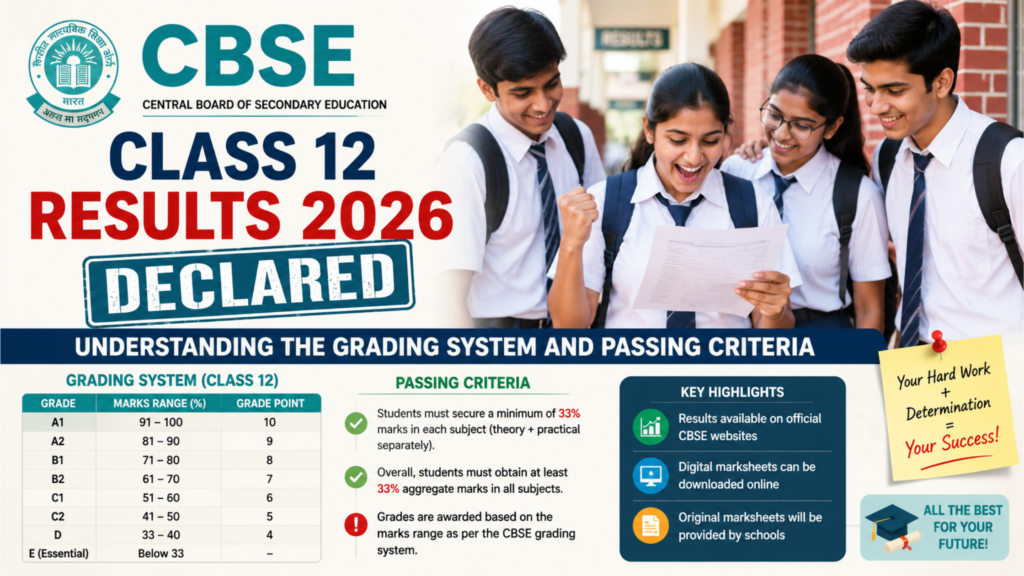
The much-awaited CBSE Class 12 Results 2026 have officially been declared, bringing relief, excitement, and curiosity for lakhs of students across India. Along with checking marks and percentages, students are also trying to understand how the CBSE grading system works and what exactly the passing criteria mean for their academic future.
The Central Board of Secondary Education follows a structured grading system designed to evaluate students fairly while reducing unnecessary pressure related to marks. Students need to secure minimum passing marks separately in theory and practical examinations to successfully clear the Class 12 board exams.
The release of CBSE Class 12 Results 2026 is not only important for school students but also for college admissions, entrance exams, scholarships, and future career planning. Understanding grades, percentage calculations, and subject-wise eligibility requirements is essential for making informed academic decisions after Class 12.
This detailed guide explains the CBSE grading pattern, passing rules, marks distribution, result evaluation system, and everything students and parents need to know.
Understanding the CBSE Grading System
The grading system used in CBSE Class 12 examinations is designed to assess overall student performance systematically. Instead of focusing only on marks, the board uses grades to categorize performance levels in different subjects.
Under the CBSE Class 12 Results 2026, students receive grades based on the range of marks scored in individual subjects. The grading pattern helps reduce extreme competition and allows students to focus more on learning outcomes rather than only percentages.
The board generally follows grade categories such as A1, A2, B1, B2, C1, C2, D, and E. Higher grades indicate stronger academic performance, while grade E is considered insufficient for passing.
The grading process is based on relative performance and overall evaluation standards set by the board. Each subject is assessed separately, and students must satisfy the minimum passing requirements in all mandatory subjects.
The CBSE grading structure also helps universities and institutions understand student performance more effectively during admission processes.
Passing Criteria in CBSE Class 12 Exams
One of the most important aspects of CBSE Class 12 Results 2026 is understanding the passing criteria. Many students mistakenly believe that overall marks alone determine pass or fail status, but the board follows subject-wise evaluation rules.
Students are required to secure at least 33 percent marks in each subject to pass the examination. This requirement applies separately to theory and practical components wherever applicable.
For subjects that include practical examinations, students must pass both sections independently. Scoring high marks in practical exams cannot compensate for failing theory exams.
The passing criteria ensure that students demonstrate minimum competency in every subject area before being declared successful.
CBSE also provides opportunities such as compartment examinations for students who fail in limited subjects. This allows students to improve their performance without losing an entire academic year.
The declaration of CBSE Class 12 Results 2026 once again highlights the importance of balanced preparation across theory, practicals, and internal assessments.
How CBSE Calculates Grades and Marks
The evaluation process used in CBSE board exams combines written examination marks, practical scores, internal assessments, and project work depending on the subject structure.
The CBSE Class 12 Results 2026 grading process reflects comprehensive assessment methods aimed at evaluating conceptual understanding, analytical skills, and practical knowledge.
Subjects such as Physics, Chemistry, Biology, Computer Science, and Physical Education include practical examination marks. Meanwhile, subjects like English and Social Sciences often include internal assessment components.
The board uses moderation and standardized evaluation practices to maintain fairness across different examination centers.
Grades are assigned according to performance ranges rather than absolute percentages alone. This system helps ensure consistency and minimizes variations caused by difficult question papers or regional evaluation differences.
The grading approach adopted by CBSE aims to encourage holistic academic development rather than rote memorization.
Why CBSE Uses a Grading System
The grading system in CBSE examinations was introduced to reduce unhealthy competition and excessive stress among students. Instead of focusing entirely on exact marks, grades help categorize overall academic performance more meaningfully.
The introduction of grades within CBSE Class 12 Results 2026 reflects the board’s long-term effort to create a more student-friendly evaluation structure.
Academic experts believe that grading systems encourage broader learning and reduce anxiety associated with minor mark differences. A student scoring 91 and another scoring 95 may both receive the same grade category, helping reduce unnecessary comparison.
The system also helps educational institutions evaluate candidates more comprehensively during admissions.
Another advantage is that grading encourages students to focus on conceptual clarity, communication skills, and practical application rather than only examination scores.
The board continues refining its evaluation methods to balance academic standards with student well-being.
Importance of CBSE Class 12 Results for Higher Education
The significance of CBSE Class 12 Results 2026 extends far beyond school education. These results play a major role in determining eligibility for college admissions, scholarships, competitive exams, and career opportunities.
Universities across India consider Class 12 board marks during undergraduate admission processes. Courses such as engineering, medicine, commerce, law, humanities, and management often use board performance as part of selection criteria.
Many entrance examinations also require minimum Class 12 qualifying percentages for eligibility. Therefore, students must understand how their grades and marks affect future academic pathways.
Scholarship programs offered by universities and private organizations may also depend on strong board exam performance.
The Class 12 result often becomes one of the first major milestones in a student’s educational journey and significantly influences future opportunities.
Challenges Students Face During Result Season
Result season can become emotionally stressful for students and families due to high expectations and academic pressure.
The release of CBSE Class 12 Results 2026 may create anxiety among students worried about career decisions, college admissions, or comparison with peers.
Educational counselors advise students to view board results as an important milestone but not the final definition of their abilities or future success.
Students who achieve excellent scores should remain focused on long-term goals, while those disappointed with results should remember that multiple career paths and improvement opportunities exist.
Parents also play an important role during this period by providing emotional support and encouraging balanced decision-making.
Mental well-being, confidence, and skill development remain equally important alongside academic performance.
Role of Internal Assessments and Practicals
Internal assessments and practical examinations contribute significantly to final board results in many subjects.
Under the CBSE Class 12 Results 2026 evaluation system, internal projects, assignments, oral tests, and practical records carry weightage depending on the subject.
Schools conduct internal assessments throughout the academic year, encouraging consistent student participation and performance.
Practical exams help evaluate laboratory skills, project understanding, communication ability, and real-world application of theoretical concepts.
Students who maintain regular attendance, complete assignments sincerely, and actively participate in practical sessions often benefit from stronger internal scores.
The combination of theory and practical evaluation helps create a more balanced and comprehensive assessment framework.
How Students Can Use Results for Career Planning
After the declaration of CBSE Class 12 Results 2026, students should carefully evaluate their interests, strengths, and future career aspirations before choosing higher education options.
Strong academic performance opens opportunities in multiple streams, but career success ultimately depends on passion, consistency, and skill development.
Students interested in science can pursue engineering, medicine, research, biotechnology, or computer science. Commerce students may explore finance, business management, economics, or chartered accountancy. Humanities students can consider law, journalism, psychology, civil services, and social sciences.
Career counseling and aptitude analysis can help students make informed decisions based on individual goals and capabilities.
Instead of following societal pressure blindly, students should focus on building careers aligned with their interests and long-term ambitions.