







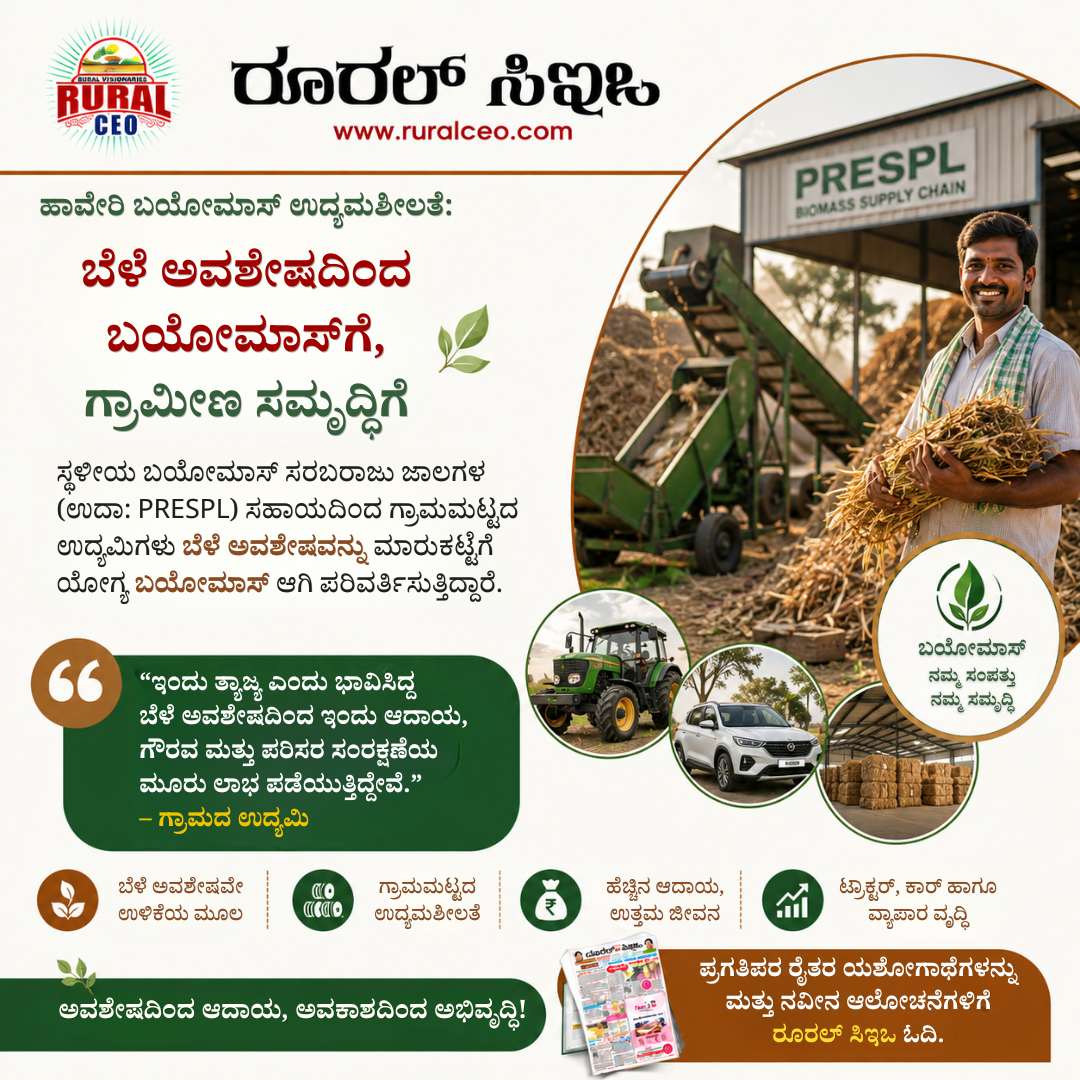
Biomass Entrepreneurship is emerging as a powerful driver of rural economic growth in Karnataka’s Haveri district. Farmers and local entrepreneurs who once struggled to find value in agricultural waste are now converting crop residue into profitable biomass products. This transformation is not only helping rural communities earn higher incomes but also creating sustainable business opportunities and supporting environmental conservation.
In Haveri, local biomass supply chains such as PRESPL are enabling village-level entrepreneurs to collect, process, and market agricultural waste efficiently. Farmers who previously burned crop residue or discarded it are now supplying thousands of tonnes of biomass annually. Many rural families have improved their financial condition significantly through this model, purchasing tractors, vehicles, and expanding their agricultural businesses.
Biomass Entrepreneurship is proving that agricultural waste can become a valuable economic resource while supporting rural employment, green energy solutions, and sustainable agriculture practices.
The Rise of Biomass Entrepreneurship in Rural Karnataka
Rural Karnataka has long depended on agriculture as its primary source of income. However, crop residue management remained a major challenge for farmers for many years. Large quantities of agricultural waste were either burned or left unused after harvest seasons, leading to environmental pollution and economic losses.
Biomass Entrepreneurship has changed this situation by creating organized biomass supply chains that connect farmers directly with industries and energy sectors. Agricultural waste such as sugarcane residue, paddy straw, and crop leftovers are now collected and processed into biomass fuel and other commercial products.
The success of biomass businesses in Haveri demonstrates how rural entrepreneurship can solve environmental problems while generating sustainable income opportunities for farming communities.
How Biomass Supply Chains Are Helping Farmers
Village-level biomass supply systems have become an important part of the rural economy. Companies like PRESPL are supporting farmers by creating organized networks for collecting agricultural waste and converting it into marketable biomass products.
Farmers who once considered crop residue as waste are now earning additional income through biomass sales. Some farmers are supplying up to 1,000 tonnes of agricultural biomass annually, creating a stable secondary income source alongside traditional farming activities.
Biomass Entrepreneurship is also generating employment opportunities for machine operators, transport workers, collection agents, and rural youth. This has strengthened local economies and reduced dependency on seasonal agricultural income.
The organized biomass model helps rural communities become financially stronger while encouraging sustainable waste management practices.
Biomass Entrepreneurship Supporting Environmental Sustainability
Agricultural waste burning has been a major environmental concern in many farming regions across India. Crop residue burning contributes to air pollution, soil degradation, and greenhouse gas emissions.
Biomass Entrepreneurship offers an environmentally friendly alternative by converting agricultural waste into useful biomass fuel and industrial raw materials. This approach reduces pollution while creating economic value from unused farm residue.
Farmers in Haveri are increasingly realizing that sustainable biomass management can improve both environmental health and rural income. By participating in biomass supply chains, they are contributing to cleaner villages and greener agricultural practices.
This combination of sustainability and profitability is one of the main reasons why biomass businesses are gaining popularity across rural India.
Rural Entrepreneurs Building Wealth Through Biomass
One of the most inspiring aspects of the Haveri biomass model is the financial growth achieved by rural entrepreneurs. Many individuals who started small-scale biomass collection businesses have expanded into successful enterprises over time.
The additional income generated through Biomass Entrepreneurship has helped several rural families invest in tractors, transport vehicles, and agricultural machinery. Some entrepreneurs have even diversified into related businesses connected to logistics and agricultural services.
This growth demonstrates how rural entrepreneurship can create long-term economic stability when supported by organized supply chains and market access.
Biomass businesses are also encouraging young people in villages to explore agriculture-related enterprises instead of migrating to cities for employment.
Technology and Innovation in Biomass Business
Modern biomass operations increasingly rely on technology-driven systems for collection, storage, processing, and transportation. Rural entrepreneurs are now using advanced agricultural equipment and digital management systems to improve efficiency.
Biomass Entrepreneurship is becoming more organized through machine-based residue collection systems and coordinated transportation networks. This has helped reduce labor challenges and improve biomass quality standards.
Digital communication platforms are also helping farmers and buyers coordinate more effectively, creating smoother biomass supply chain operations.
The integration of technology with rural entrepreneurship is strengthening the overall agricultural economy and improving productivity.
Challenges Facing Biomass Entrepreneurs
Although biomass business opportunities are growing rapidly, rural entrepreneurs still face certain challenges. Transportation costs, storage infrastructure, seasonal supply variations, and limited awareness continue to affect some regions.
Small entrepreneurs often require better financial support and policy assistance to expand their biomass operations successfully. Access to modern machinery and training programs can also improve business efficiency.
Government support and private sector participation will play an important role in strengthening the future of Biomass Entrepreneurship in India.
Despite these challenges, the success stories emerging from Haveri prove that rural biomass enterprises have strong long-term growth potential.
Why Biomass Entrepreneurship Matters for Rural India
India produces massive quantities of agricultural residue every year. Proper utilization of this biomass can support renewable energy production, rural employment, and sustainable development goals.
Biomass Entrepreneurship creates a circular rural economy where agricultural waste becomes a valuable economic asset instead of an environmental burden.
This model supports:
- Rural income generation
- Sustainable agriculture
- Green energy solutions
- Employment creation
- Waste management improvement
As India focuses more on clean energy and rural development, biomass enterprises are expected to become increasingly important.



flux 2
May 28, 2026It’s inspiring to see how Haveri’s farmers are turning crop residue into a valuable resource. Initiatives like this show how sustainability and entrepreneurship can go hand in hand to strengthen rural economies. Highlighting local innovation like this could motivate other regions to explore similar approaches.