








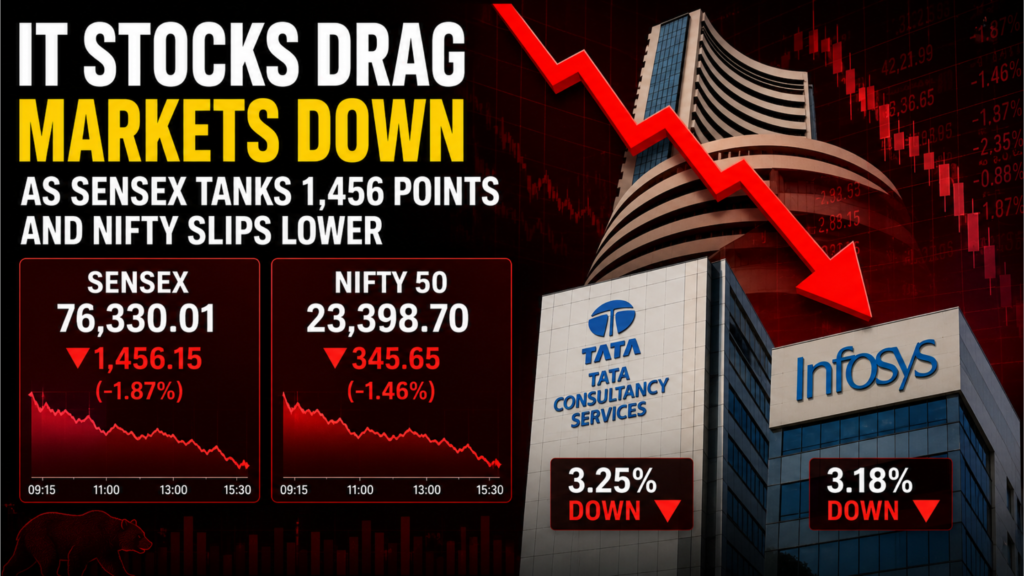
The Indian stock market witnessed one of its sharpest declines in recent sessions as Sensex crashes today became the biggest headline across financial media platforms. Heavy selling pressure in major IT stocks such as Tata Consultancy Services and Infosys dragged benchmark indices deep into the red, causing the Sensex to tank 1,456 points while the Nifty slipped below the important 23,400 level.
Investors across Dalal Street reacted nervously to global market weakness, recession fears, and continued uncertainty in the technology sector. The sudden decline in heavyweight IT shares triggered panic selling across multiple sectors, resulting in broad market weakness throughout the trading session.
The phrase Sensex crashes today quickly began trending because the fall reflected growing investor concerns over earnings growth, foreign institutional investor outflows, and global economic pressure. Market analysts believe the correction also signals a cautious mood among traders ahead of upcoming economic data and corporate earnings announcements.
Why IT Stocks Led the Market Crash
The Indian IT sector has long been considered one of the strongest pillars of the stock market. However, during this session, technology stocks experienced intense selling pressure as investors feared weaker global demand and slowing international business spending.
Companies like Tata Consultancy Services and Infosys fell more than 3%, significantly impacting benchmark indices due to their high market capitalization weightage. Since IT companies generate a large portion of their revenue from international markets, global economic concerns often directly influence investor sentiment toward the sector.
The phrase Sensex crashes today gained attention largely because IT stocks contributed heavily to the decline. Analysts noted that concerns regarding reduced technology spending in the United States and Europe created fresh pressure on Indian software exporters.
Weak global cues, uncertainty surrounding interest rate policies, and fears of slower corporate growth added further negativity to the market environment. Investors preferred reducing exposure to riskier sectors, leading to aggressive selling activity in technology shares.
Global Factors Behind the Market Sell-Off
The Indian market does not operate in isolation, and global economic developments continue to influence domestic investor sentiment. Several international factors contributed to the market decline seen today.
Rising bond yields in the United States created pressure on emerging markets, including India. Foreign investors often shift money away from equities when safer investment options offer better returns. This shift in capital flow negatively affects stock market stability.
Global recession concerns also intensified after weak economic indicators from major economies suggested slower business growth ahead. Technology companies are particularly vulnerable during uncertain economic periods because businesses usually reduce discretionary spending on digital expansion and software investments.
The reason Sensex crashes today became such a widely discussed topic is because investors are increasingly worried about global instability impacting Indian corporate earnings. Market participants are closely monitoring inflation data, central bank decisions, and international trade developments for future direction.
Nifty Slips Below Key Support Levels
While the Sensex experienced a major decline, the Nifty also slipped below the psychologically important 23,400 mark. Technical analysts consider such levels extremely important because they influence short-term trading sentiment and investor confidence.
The fall below support zones triggered additional selling pressure as traders rushed to protect positions and limit losses. Banking, auto, and financial stocks also faced weakness during the session, although the IT sector remained the primary drag on the market.
The phrase Sensex crashes today reflects broader market nervousness rather than weakness in just one sector. Investors are now watching whether the market can stabilize or whether additional downside pressure could emerge in upcoming sessions.
Short-term market volatility often increases when benchmark indices break critical technical levels. This situation creates uncertainty among retail investors and encourages cautious trading behavior.
Impact on Retail Investors
Retail investors were among the most affected groups during today’s sharp correction. Many new investors entered the market during recent bullish phases and may not have experienced such sudden declines before.
Market experts advise investors not to panic during volatile sessions because corrections are a natural part of long-term investing. However, emotional reactions often dominate when headlines like Sensex crashes today spread rapidly across financial news channels and social media platforms.
Several investors used the correction as an opportunity to accumulate fundamentally strong companies at lower valuations. Long-term investors generally focus on business quality and earnings potential rather than reacting to short-term fluctuations.
At the same time, traders faced significant pressure due to rapid intraday volatility. Stop-loss levels were triggered across multiple sectors, resulting in increased trading activity throughout the day.
What Analysts Are Saying About the Market Fall
Market analysts believe the correction reflects a combination of domestic and international pressures rather than a single isolated event. While global uncertainty remains a concern, experts suggest that Indian economic fundamentals continue to remain relatively strong compared to many other economies.
The strong domestic consumption story, government infrastructure spending, and stable banking sector performance still support long-term market confidence. However, near-term volatility may continue if global uncertainty remains elevated.
The phrase Sensex crashes today may sound alarming, but several analysts argue that corrections often create healthier market conditions by reducing excessive valuations and speculative activity.
Some experts also highlighted that the technology sector could remain under pressure if international demand slows further. Investors are therefore closely watching quarterly earnings guidance from major IT companies.
How Foreign Investors Influenced Market Sentiment
Foreign Institutional Investors play a major role in determining market direction because of the large volumes they trade daily. Recent FII selling activity contributed significantly to market weakness.
Global investors have become cautious due to rising interest rates, geopolitical tensions, and economic uncertainty. Emerging markets like India often witness capital outflows during periods of international risk aversion.
The reason Sensex crashes today became a major financial headline is partly due to concerns about sustained foreign investor withdrawals. Continued selling by international funds can create additional pressure on domestic markets.
However, domestic institutional investors provided some support during the session by selectively buying quality stocks at lower prices. This helped prevent an even steeper decline.