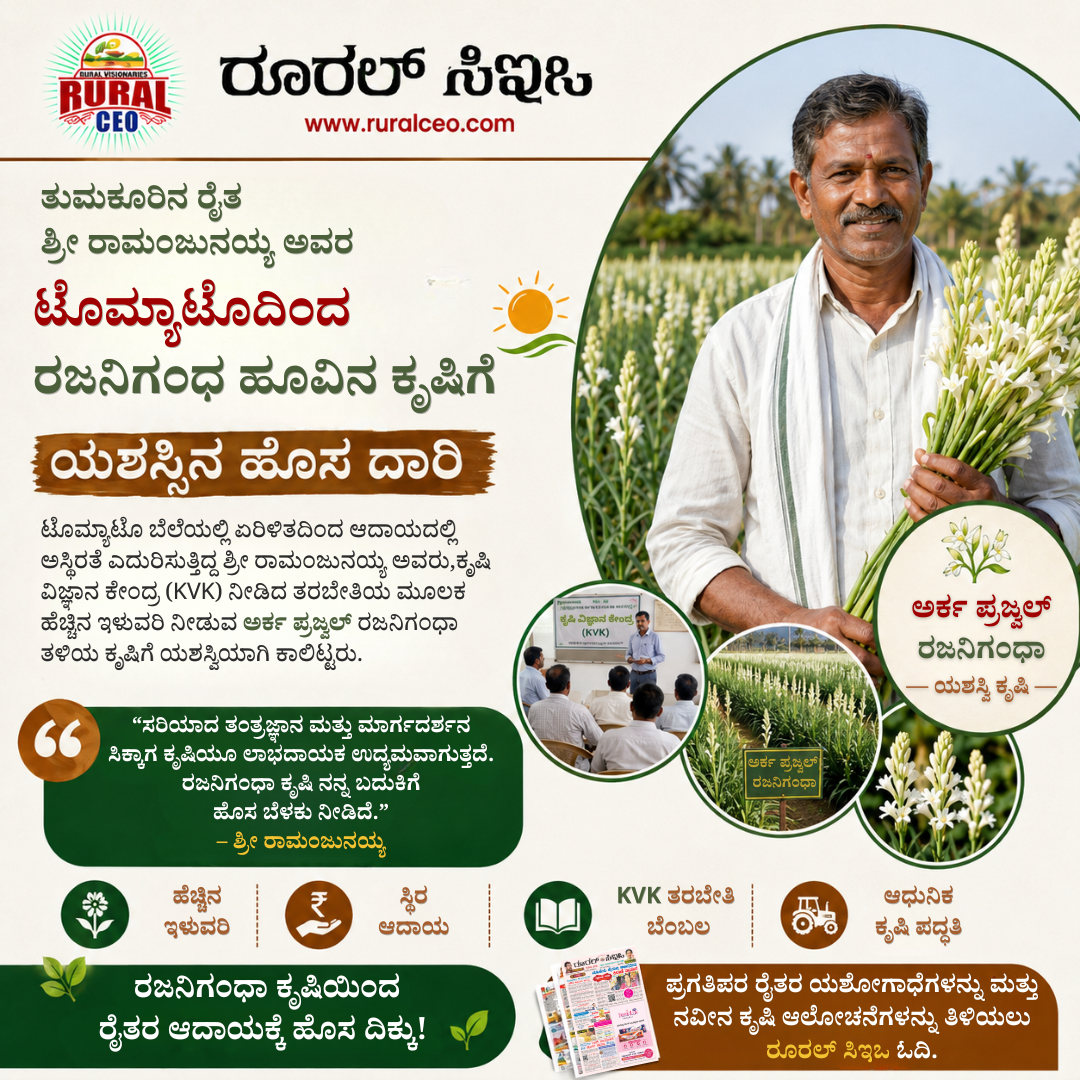

Agriculture often requires farmers to adapt to changing market conditions and explore new opportunities. For many growers, fluctuating crop prices can create uncertainty and financial stress. This was the reality for Sri Ramanjunaiah, a farmer from Tumakuru, Karnataka, who struggled with unstable income due to frequent price fluctuations in tomato cultivation. His inspiring transformation through Tuberose Farming demonstrates how the right training, technical guidance, and crop diversification can create a sustainable path to success.
After receiving support from the local Krishi Vigyan Kendra (KVK), Sri Ramanjunaiah shifted from tomato cultivation to growing Arka Prajwal, a high-yielding variety of tuberose. The decision proved to be life-changing. Today, he enjoys more stable earnings, improved productivity, and greater confidence in his farming enterprise. His story highlights the growing potential of floriculture as a profitable alternative for farmers seeking long-term sustainability and higher returns.
A Farmer’s Struggle with Tomato Cultivation
Like many farmers across India, Sri Ramanjunaiah relied heavily on tomato cultivation for his livelihood. While tomatoes can generate significant profits during favorable market conditions, the crop is highly vulnerable to price fluctuations. Sudden drops in market rates often result in losses that can erase months of hard work.
Unpredictable weather patterns, fluctuating demand, and market oversupply further increased the risks associated with tomato farming. Despite his dedication and experience, maintaining a consistent income became increasingly difficult.
These challenges forced him to explore alternative agricultural opportunities that could provide greater stability and profitability.
How KVK Training Changed Everything
The turning point came when Sri Ramanjunaiah participated in technical training programs conducted by the Krishi Vigyan Kendra (KVK). These programs introduced farmers to innovative agricultural practices, crop diversification strategies, and emerging market opportunities.
During the training sessions, he learned about the commercial potential of floriculture and the benefits of cultivating Arka Prajwal tuberose. Experts explained how flower cultivation could generate steady demand, better price realization, and lower market volatility compared to certain vegetable crops.
Encouraged by the scientific guidance and practical demonstrations provided by KVK experts, he decided to adopt tuberose cultivation as a new venture.
Tuberose Farming Creates a New Path to Success
The shift to Tuberose Farming marked a significant turning point in Sri Ramanjunaiah’s agricultural journey. Arka Prajwal is known for its high yield, attractive flowers, and strong market demand. These characteristics make it one of the most popular tuberose varieties among commercial flower growers.
Unlike tomatoes, tuberose flowers offer multiple marketing opportunities. Farmers can sell fresh flowers for religious ceremonies, weddings, decorations, and floral industries. This diversified demand helps reduce dependence on a single market channel.
The transition allowed Sri Ramanjunaiah to build a more stable income stream while reducing the risks associated with fluctuating vegetable prices.
Why Arka Prajwal Tuberose is Popular Among Farmers
Arka Prajwal has gained widespread popularity due to its superior performance and commercial value. Developed through agricultural research in, the variety offers several advantages that attract progressive farmers.
Some of the key benefits include:
- Higher flower yield in Tuberose Farming compared to traditional varieties.
- Strong demand in domestic flower markets.
- Tuberose Farming is Long flowering duration.
- Better profitability potential.
- Suitable for commercial floriculture enterprises.
These advantages make the variety particularly attractive for farmers seeking diversification and sustainable growth.
The Economic Impact of Floriculture
Floriculture is becoming an increasingly important sector within Indian agriculture. As consumer demand for flowers continues to rise, farmers are finding new opportunities to increase their income through commercial flower production.
For Sri Ramanjunaiah, Tuberose Farming provided access to a growing market that values quality Tuberose Farming flower production. The crop’s consistent demand helped reduce income uncertainty and improve financial planning.
The success of floriculture demonstrates how diversification can strengthen rural economies while creating additional employment opportunities in cultivation, harvesting, transportation, and marketing.
Building Confidence Through Innovation
One of the most significant outcomes of Sri Ramanjunaiah’s journey has been the confidence gained through innovation. Farmers often hesitate to move away from traditional crops due to uncertainty and risk.
However, access to scientific knowledge and practical training can empower farmers to make informed decisions. The support provided by KVK experts played a crucial role in helping him successfully transition to a new crop in Tuberose Farming.
Today, his success serves as an inspiration for other farmers who are considering alternative agricultural enterprises.
Lessons for Modern Farmers
The experience of Sri Ramanjunaiah offers valuable lessons for farmers across India. Agriculture is constantly evolving, and adapting to changing market conditions is essential for long-term success.
Key takeaways from his journey include:
- Diversification can reduce financial risk.
- Scientific training improves decision-making.
- High-value crops can enhance profitability.
- Market research is essential before crop selection.
- Innovation creates new opportunities for growth.
These lessons can help farmers improve resilience and achieve greater sustainability in their agricultural operations.
The Future of Tuberose Farming in India
As demand for flowers continues to increase, Tuberose Farming is expected to play an important role in the future of Indian floriculture. Rising urbanization, cultural events, religious activities, and decorative uses contribute to a growing market for fresh flowers.
Government agencies, research institutions, and agricultural extension centers are also promoting floriculture as a viable income-generating activity. Improved varieties, better cultivation techniques, and enhanced market access continue to strengthen the sector.
Farmers who embrace innovation and adopt modern cultivation practices are likely to benefit from these expanding opportunities.