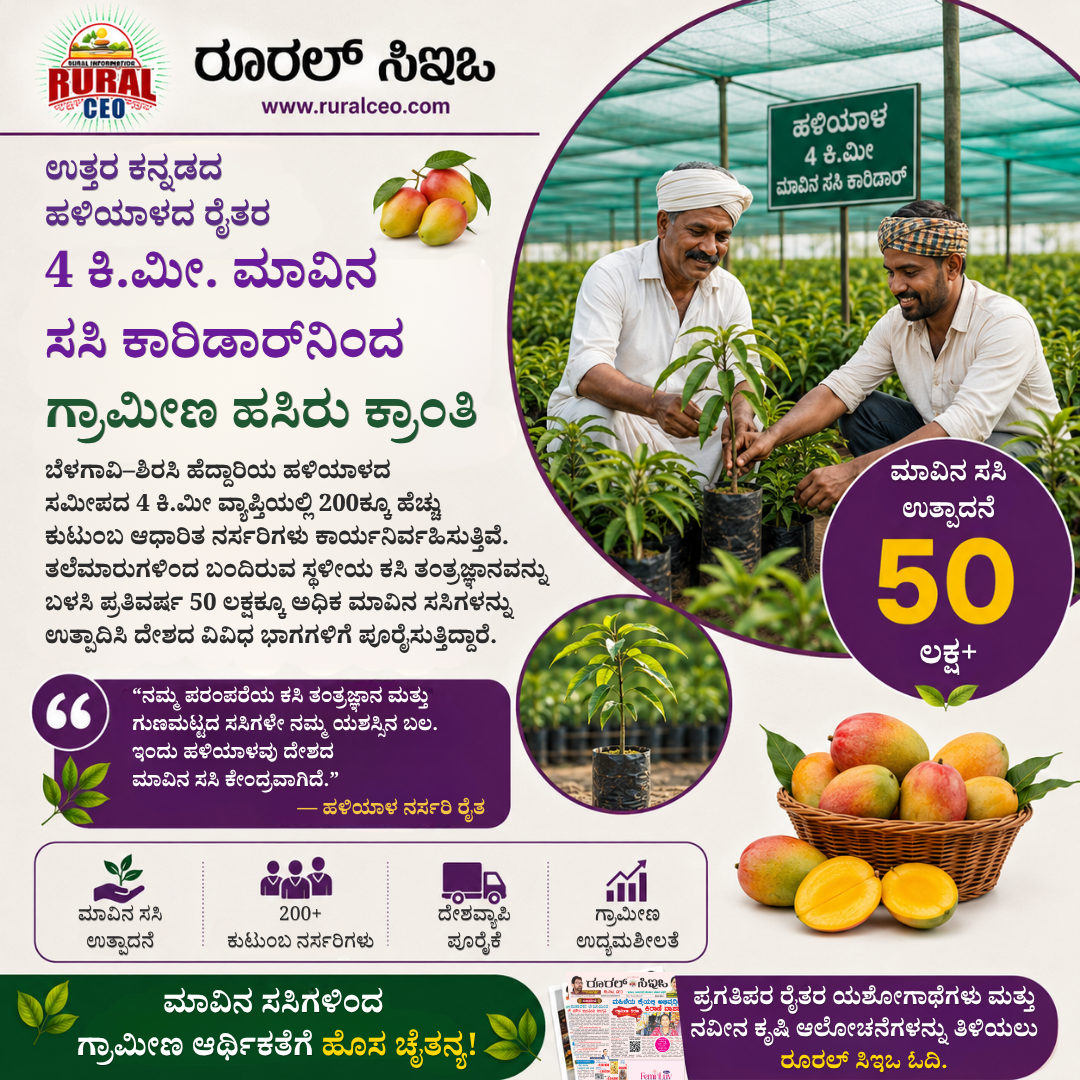



Along the Belagavi–Sirsi highway near Haliyal in Uttara Kannada district, a remarkable rural success story is quietly transforming the agricultural landscape. More than 200 family-run nurseries in a four-kilometer stretch are producing over 50 lakh Mango Saplings every year, creating one of India’s most significant horticultural clusters. These nurseries have become a vital part of the country’s mango cultivation ecosystem, supplying high-quality grafted plants to farmers, orchard owners, and agricultural entrepreneurs across multiple states.
Their success is built on generations of expertise, traditional grafting knowledge, and a strong commitment to quality. As demand for mango cultivation continues to rise, Haliyal has emerged as a leading hub for nursery-based rural entrepreneurship, generating employment, strengthening local economies, and supporting India’s thriving horticulture sector.
The Rise of Haliyal’s Mango Nursery Industry
What makes Haliyal unique is not just the volume of production but the concentration of expertise within a relatively small geographic area. For decades, local farming families have specialized in nursery management and grafting techniques that ensure healthy, productive mango plants.
Over time, these family enterprises evolved into a highly organized supply chain capable of meeting growing demand from farmers across India. Today, the region is widely recognized for producing premium-quality Mango Saplings that contribute significantly to orchard development in multiple states.
The Mango Saplings success of these nurseries demonstrates how traditional agricultural knowledge can be transformed into a sustainable rural business model.
How Traditional Grafting Techniques Create High-Quality Mango Saplings
The foundation of Haliyal’s success lies in its locally developed grafting expertise. Families pass these specialized techniques from one generation to the next, preserving valuable horticultural knowledge while continuously improving production quality.
Grafting allows growers to combine strong rootstock with superior fruit-bearing varieties. This process produces plants that offer better yields, improved disease resistance, and consistent fruit quality.
Because of these advantages, farmers prefer purchasing professionally prepared Mango Saplings from established nurseries rather than relying solely on seed-grown plants. The reputation for quality has helped Haliyal become a trusted source for nursery stock throughout India.
A Rural Green Revolution Driven by Family Enterprises
Unlike large industrial operations, Haliyal’s nursery sector is built primarily on family-owned businesses. Parents, children, and extended family members actively participate in nursery management, plant propagation, packaging, and distribution.
This family-centered model creates multiple economic benefits within rural communities. Employment opportunities remain local, profits are reinvested into village economies, and agricultural skills continue to be preserved for future generations.
The nursery industry has also encouraged young people to view agriculture as a viable entrepreneurial opportunity rather than migrating exclusively toward urban employment.
Economic Impact on Uttara Kannada
The annual production of more than 50 lakh Mango Saplings has transformed Haliyal into an important economic center within Karnataka’s horticulture sector.
The industry’s impact extends beyond nursery owners. Transportation providers, agricultural suppliers, laborers, packaging businesses, and local service providers all benefit from the thriving nursery ecosystem.
Several positive outcomes include:
- Increased rural employment opportunities.
- Stronger village economies.
- Growth in horticultural entrepreneurship.
- Higher agricultural incomes.
- Expansion of India’s mango cultivation area.
This interconnected value chain demonstrates how a specialized agricultural activity can generate widespread economic development.
Supporting India’s Expanding Mango Industry
India is the world’s largest producer of mangoes, and demand for new orchards continues to grow. Farmers are increasingly investing in commercial mango cultivation due to strong domestic and export market opportunities.
As a result, reliable sources of quality nursery plants have become essential. Haliyal’s nurseries play a crucial role in meeting this demand by supplying healthy grafted plants suitable for commercial orchard development.
The production of high-quality Mango Saplings helps farmers establish productive orchards that generate long-term returns while supporting national fruit production goals.
Innovation Meets Tradition
Although traditional knowledge remains central to nursery operations, many growers have adopted modern techniques to improve efficiency and quality.
Advancements include:
- Improved irrigation systems.
- Better nursery management practices.
- Scientific pest control methods.
- Enhanced packaging and transportation.
- Improved variety selection.
By combining innovation with tradition, Haliyal nursery owners continue to strengthen their competitive advantage while maintaining the quality standards that have built their reputation.
The Role of Rural Entrepreneurship
The success of Haliyal nursery cluster is a powerful example of rural entrepreneurship in action. Instead of depending solely on conventional farming, local families have built specialized businesses that create value throughout the agricultural supply chain.
Their achievements demonstrate that agriculture offers opportunities far beyond crop cultivation. Nursery management, plant propagation, and horticultural services represent profitable sectors capable of driving long-term rural development.
This entrepreneurial spirit has become one of the defining characteristics of the region’s success story.
Why Haliyal Model Matters for Rural India
As policymakers and development experts seek sustainable strategies for rural growth, Haliyal offers a practical model that can be replicated elsewhere.
The region’s success highlights several important principles:
- Leveraging local expertise.
- Preserving traditional agricultural knowledge.
- Encouraging family-owned enterprises.
- Building specialized agricultural clusters.
- Creating employment through value-added agriculture.
These lessons provide valuable insights for communities seeking new pathways to economic development.